
Guides
How to Read a VIN Number: U.S. 17-Character Format Guide

How to read a VIN number begins with recognition of the 17-character U.S. format. The format encodes manufacturer identity, vehicle attributes, a check digit, model year and plant information in fixed positions.
For exporters, dealers and importers, position-by-position reading supports consistent vehicle identification across listings, inspections and shipping documents. An official decoder and recall lookup then provide a manufacturer-reported cross-check, not proof of full specification or import compliance.
What a VIN Is and When the 17-Character Format Applies
Under U.S. federal VIN requirements, each VIN consists of 17 characters. The VIN alphabet excludes the letters I, O and Q.
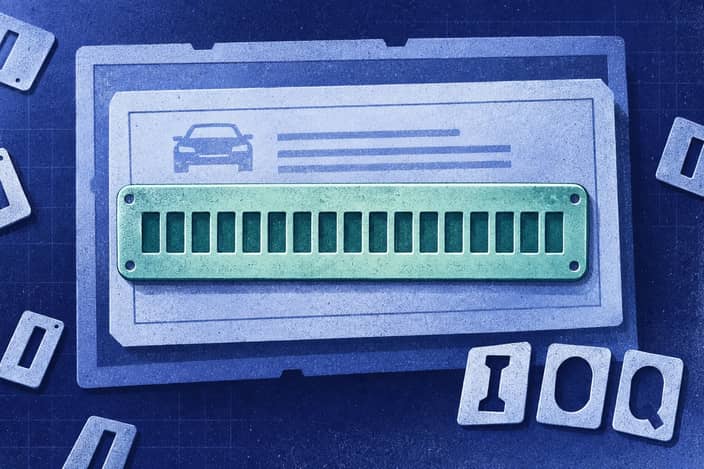
The 17-character system applies to vehicles manufactured for the U.S. market beginning with model year 1981. That scope matters for trade operations because older vehicles, non-U.S.-format identifiers and incomplete numbers from documents or photographs may not follow the same structure.
The federal regulation formally describes four VIN sections. Positions 1 through 3 identify the manufacturer section, positions 4 through 8 describe vehicle attributes, position 9 carries a check digit, and positions 10 through 17 complete the vehicle identifier section.
| VIN section | Positions | Function |
|---|---|---|
| World Manufacturer Identifier | 1–3 | Identifies the manufacturer section |
| Vehicle Descriptor Section | 4–8 | Encodes vehicle attributes |
| Check digit | 9 | Supports transcription verification |
| Vehicle Identifier Section | 10–17 | Includes model year and plant |
For inventory control, the fixed length and fixed section boundaries allow staff to detect truncated numbers, added spaces and mixed document formats before further checks are performed.
Read VIN Positions 1–8: Manufacturer and Vehicle Details
VIN positions 1–3 form the World Manufacturer Identifier, or WMI, section. The WMI identifies the manufacturer portion of the VIN and provides the starting point for confirming the reported make in later decoder results.
VIN positions 4–8 form the Vehicle Descriptor Section, or VDS. The VDS encodes vehicle attributes, while manufacturers choose how to encode those attributes and provide information for decoding. The VDS is therefore not a universal character-by-character code across all brands.
The required attributes differ for passenger cars and trucks, as summarised below.
| Vehicle group | Attributes encoded in positions 4–8 |
|---|---|
| Passenger cars | Line, series, body type, engine type, restraint-system type |
| Trucks | Model or line, series, chassis, cab type, engine type, brake system, gross vehicle weight rating |
The practical implication is that identical letters or numbers in positions 4 through 8 can carry different meanings by manufacturer. Exporters and importers therefore treat positions 1 through 8 as a structured pointer to manufacturer specifications, rather than as a complete specification in themselves.
Check Position 9: The VIN Check Digit
For the U.S. VIN format covered by 49 CFR Part 565, position 9 is a check digit used to help verify the accuracy of a VIN transcription. The permitted value is a digit from 0 to 9 or the letter X.
The check digit is particularly relevant where VINs are copied from labels, photographs, auction sheets, registration documents and customs paperwork. A mismatch at position 9 signals that the number should be rechecked against the physical plate or label, as the failure may reflect a transcription error or another issue with the recorded number.
Calculation follows the regulatory method. Each VIN character is converted using the regulatory values, each value is multiplied by its position weight, the products are added, and the total is divided by 11. Remainders 0–9 correspond to digits 0–9, while remainder 10 corresponds to X. Position 9 carries weight 0 in the calculation.
The result confirms internal consistency only.
Read Positions 10–11: Model Year and Manufacturing Plant
Position 10 represents model year. The federal table assigns S to 2025, T to 2026 and V to 2027. Model-year codes repeat across cycles, so accurate interpretation depends on the broader age and model context.

| Position 10 code | Model year |
|---|---|
| S | 2025 |
| T | 2026 |
| V | 2027 |
For passenger cars and certain lighter multipurpose vehicles and trucks, a numeric character in position 7 indicates the 1980–2009 range, while an alphabetic character in position 7 indicates the 2010–2039 range. That distinction helps distinguish repeated model-year codes in long-running records.
A vehicle model year is the year used to designate a discrete vehicle model, regardless of the calendar year of actual production, provided the production period does not exceed 24 months. Position 10 therefore identifies the designated model year, not necessarily the build date.
Position 11 represents the plant of manufacture. The regulation defines this as the plant where the manufacturer affixes the VIN. For logistics and provenance records, the plant code is most useful when combined with decoder output on build plant and country, rather than interpreted alone.
Use an Official VIN Decoder
The NHTSA vPIC VIN Decoder accepts a full VIN and reports vehicle information submitted by the manufacturer, including the build plant and country. The result makes the tool suitable as a manufacturer-data cross-check against seller descriptions, photographs and documents.
Reported details may include make, model, model year, series, engine and body information. NHTSA describes model, series, engine, body and base safety-system data as minimum required data.
If information is missing or appears incorrect, NHTSA advises contact with the manufacturer. A vehicle label may also provide additional information where decoder fields are incomplete.
Vehicles built in South Korea, including many Korean domestic-market models, are a common source of exporter stock, and the VDS layout for these models is defined by each manufacturer. For VINs beginning with KL to KR, the Korean VIN decoder reads make, model, model year, fuel, engine and trim details from the seventeen-character VIN. Coverage is deepest for Hyundai and Kia and partial for Genesis, Chevrolet, Renault Korea and KG Mobility. Trim is often not shown, because manufacturers do not encode it in the VIN. The decoder lists possible trims or marks details as not determined rather than estimating them. It decodes up to 20 VINs per hour from one browser and does not store the VIN. As with the NHTSA tool, treat the output as a cross-check against listings and documents, not proof of full specification.
For trading workflows, the disciplined sequence is transcription verification, position-by-position reading, decoder comparison and document comparison. Differences in model, series, engine, body type or plant information warrant further documentation before pricing, purchase or shipment decisions proceed.
Verify the VIN, Recall Status, and Import-Compliance Limits
NHTSA recall lookup allows a VIN search for unrepaired recalls. A result of 0 unrepaired recalls associated with this VIN means that no unrepaired recall is shown in that search. The result does not necessarily establish that the vehicle has never had a recall.

The recall system has defined operational limits. The VIN or plate search does not show recalls already repaired, some newly announced recalls before all affected VINs are identified, certain recalls more than 15 years old, some small-manufacturer recalls, non-safety campaigns or recalls involving international vehicles. VINs are added continuously, so a repeat check may be useful in longer transactions and inventory holding periods.
For higher-volume operations, NHTSA offers bulk recall lookup for up to 100 VINs. The bulk function supports screening of auction purchases, incoming inventory and pre-shipment lists without repeated single-VIN entry.
A VIN alone cannot establish whether a particular vehicle was manufactured to meet all applicable U.S. Federal Motor Vehicle Safety Standards. For U.S. import compliance, NHTSA identifies the permanently affixed manufacturer certification label as relevant evidence. Decoder output and recall results therefore support due diligence, while compliance assessment depends on the applicable standards, labels and import procedures for the vehicle concerned.
Sources
- eCFR — 49 CFR Part 565 — Vehicle Identification Number (VIN) Requirements
- NHTSA — Outline for New Manufacturer Information
- NHTSA — Final Rule Vehicle Identification Number Requirements
- NHTSA — New Manufacturer’s Handbook
- Legal Information Institute — 49 CFR § 565.25 – Content requirements
- National Highway Traffic Safety Administration, U.S. Department of Transportation — 49 CFR § 565.15, “Content requirements”
- National Highway Traffic Safety Administration, U.S. Department of Transportation — 49 CFR § 565.12, “Definitions”
- National Highway Traffic Safety Administration (NHTSA) — VIN Decoder
- National Highway Traffic Safety Administration (NHTSA) — Vehicle Identification Number (VIN), Using Manufacturer VIN Specifications as a Standard
- National Highway Traffic Safety Administration (NHTSA) — Importation and Certification FAQs
- National Highway Traffic Safety Administration (NHTSA) — Check for Recalls: Vehicle, Car Seat, Tire, Equipment