
Guides
How Much Does It Cost to Import a Used Car to the UK in 2026?
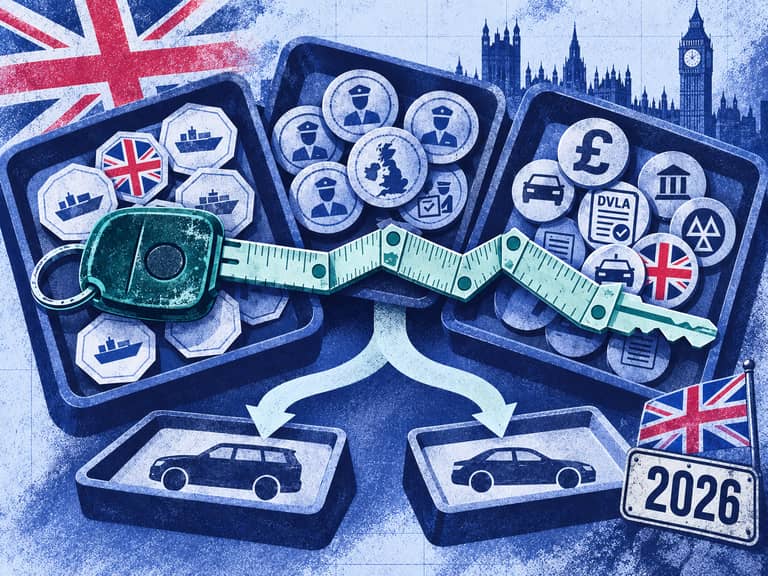
The cost of importing a used car to the United Kingdom consists of several separate charges. Border taxes are calculated from the customs value and tariff treatment of the specific vehicle. Approval, registration and vehicle tax are added after arrival.
The central finding is that no universal import price exists. The cited tariff examples show a 10% third-country duty rate and a 20% VAT rate, but the applicable duty depends on classification, origin and trade arrangements. The route also matters, because Great Britain and Northern Ireland follow different declaration and VAT rules.
For dealers, exporters and importers, the practical task is therefore to build a vehicle-specific estimate. Customs value, origin, age, emissions and registration route each change the total.
What Counts As The Cost Of Importing A Used Car?
A landed-cost estimate for a used car contains border charges and domestic compliance charges. Border charges are customs duty and import VAT. Domestic charges include vehicle approval or testing, the DVLA registration fee and vehicle tax at registration.
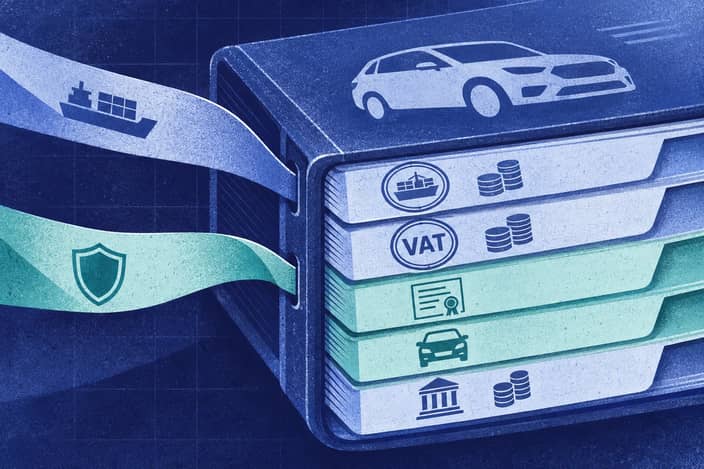
Transport and insurance form part of the calculation in two ways. They are commercial costs paid to the carrier and insurer. They can also enter the VAT base when they form part of the incidental expenses to the first UK destination and, where known at import, to a further UK destination. Accessories, delivery charges and other import charges can also affect the VAT amount.
Transfer of residence relief is a separate consideration for private moves. The relief may cover a private motor vehicle. Listed conditions include living outside the United Kingdom for at least 12 consecutive months, importing the goods within 12 months of the move, and possessing the goods for at least 6 months before the move. Goods granted relief generally cannot be lent, hired out, transferred or used as security within 12 months of the move.
Customs Duty And Import VAT: The Main Border Costs
Customs duty is assessed on the customs value under the applicable commodity code and tariff treatment. The cited used passenger-car examples carry a 10% third-country duty rate. The tariff guidance states that the applicable rate depends on vehicle classification, origin and tariff treatment, so the same model can attract a different result where preference or origin conditions differ.
Import VAT is then calculated on a VAT value that starts with the customs value. The base also includes relevant incidental expenses, customs duty, and applicable excise duty or other import charges. The cited used-car examples carry a 20% VAT rate. Because duty is included in the VAT base, duty increases the VAT amount as well as forming a charge in its own right.
The arithmetic where no additional costs enter the VAT base can be illustrated as follows. A customs value of £10,000 gives duty of £1,000 at 10 percent, a VAT base of £11,000, VAT of £2,200 at 20 percent and total duty and VAT of £3,200. It is a calculated example, not an HMRC example.
The illustration explains why small differences in declared value, freight or duty treatment have a compounded effect. A higher customs value raises duty, and the higher duty then raises the VAT base. Accurate valuation and correct classification are therefore central to cost control.
Buying In The EU: Origin, Declarations And Northern Ireland Rules
There is no single import-tax rate for every car bought in the European Union. VAT is charged on the total cost of the vehicle plus accessories, delivery, extra charges and customs duty. The duty rate depends on vehicle type and the place from which the vehicle is imported.
A car bought or shipped from the European Union does not necessarily qualify as EU-originating. A reduced or zero tariff under the United Kingdom and European Union trade arrangements can be claimed only where the car meets the origin rules and the importer holds proof of origin. A retrospective claim can be made within 3 years of import. Without qualifying origin and evidence, a reduced or zero rate cannot be claimed.
Declaration requirements depend on the destination within the United Kingdom. A vehicle brought into Great Britain requires an import declaration regardless of where it came from. A vehicle brought into Northern Ireland from the European Union does not require one. Imports into Northern Ireland from outside the European Union generally do require a declaration.
Northern Ireland also has a specific VAT test for vehicles from the European Union. VAT is usually charged only where the vehicle is new. A vehicle is new where it has been driven less than 6,000 km or has been in use for no more than 6 months. To be treated as used under both tests, the vehicle must have been driven at least 6,000 km and have been in use for more than 6 months. A used vehicle that meets both thresholds is therefore treated differently from a low-mileage or recently first-used vehicle.
Approval, Testing And DVLA Registration Costs
An imported vehicle must be notified to HMRC through the Notification of Vehicle Arrivals system within 14 days of permanent arrival. The vehicle cannot be registered until the application has been processed.
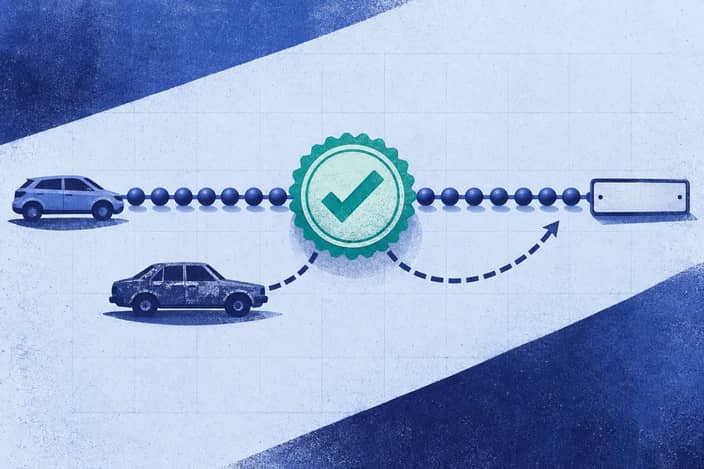
Proof of vehicle approval is needed to register and tax an imported vehicle. A vehicle first registered or manufactured more than 10 years ago might be exempt. Vehicles not registered in the European Union may need Individual Vehicle Approval. A vehicle registered in the European Union may use a manufacturer Certificate of Conformity, while a left-hand-drive vehicle from the European Union also needs GB conversion Individual Vehicle Approval. The approval route therefore depends on age, prior registration and steering configuration.
Where Individual Vehicle Approval is required, inspection fees add a fixed compliance cost. For a statutory basic Individual Vehicle Approval personal import, class P, the inspection fee is £199 in working hours or £294 outside working hours. The published fees do not include VAT.
The DVLA first-registration fee for a permanently imported vehicle is £55. The vehicle must also be taxed at registration. Registration therefore always adds at least the fixed fee plus the first vehicle tax payment, with possible approval and conversion costs in addition.
Vehicle Tax After Import: First-Year And Ongoing Rates
Vehicle tax is a material part of the first-year cost for many used imports. For cars first registered on or after 1 April 2017, the first vehicle tax payment covers 12 months and is based on carbon dioxide emissions. Current first-year rates range from £10 to £5,690. Low-emission vehicles therefore carry a much lower first tax payment than high-emission vehicles with the same customs value.
Fuel type also affects selected bands. For cars first registered on or after 1 April 2017 in the 131 to 150g per km carbon dioxide band, the first-year rate is £560 for petrol, qualifying diesel, alternative-fuel and zero-emission cars, compared with £1,410 for other diesel cars. The difference illustrates why emissions data and fuel classification should be checked before purchase, because two vehicles with similar market prices can have different first-year tax liabilities in this band.
For cars first registered on or after 1 April 2017, subsequent tax periods follow the standard rate. The current standard rate is £200 for 12 months, £110 for a single six-month payment, or £105 for a six-month Direct Debit payment. Payment by 12 monthly Direct Debit instalments costs £210 in total.
Build A Vehicle-Specific Landed-Cost Estimate
A reliable estimate starts with the vehicle particulars. The customs value, commodity classification, country of manufacture and dispatch, emissions figure, fuel type, age, prior registration and steering layout each affect at least one charge. Mileage and date of first use are also relevant for the Northern Ireland new-vehicle test.
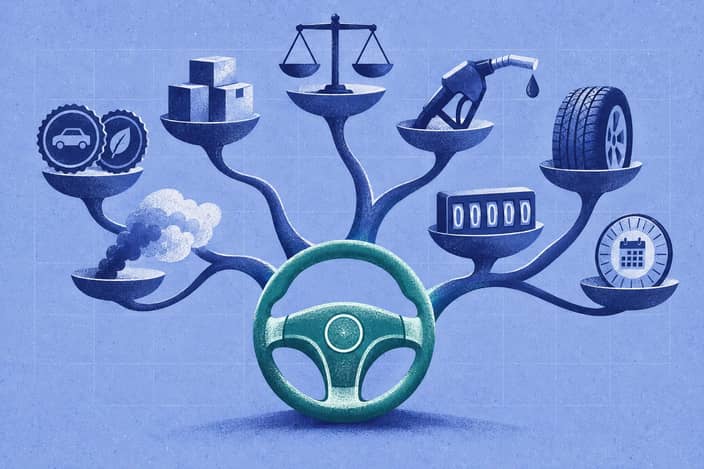
Border and domestic charges should then be estimated for each candidate vehicle and route using the rules explained above, with origin compliance confirmed before shipment where preference is expected. This structure produces a comparable landed cost for each candidate vehicle and route, rather than a single average import price.
Total Cost Summary
The table below brings together the charges covered above. Freight, insurance and any Certificate of Conformity or conversion costs are not included, and freight and insurance would also raise the VAT base where they form part of the incidental expenses.
| Charge | Basis | Amount |
|---|---|---|
| Customs duty | Customs value, by classification, origin and tariff treatment | 10% (cited third-country rate); reduced or zero with qualifying UK–EU origin and proof |
| Import VAT | Customs value + incidental expenses + duty + other import charges | 20% |
| Individual Vehicle Approval (if required) | Basic IVA, personal import, class P | £199 working hours / £294 outside working hours (excl. VAT) |
| DVLA first registration | Permanently imported vehicle | £55 |
| First vehicle tax | Cars first registered on or after 1 April 2017, by CO₂ emissions | £10 to £5,690 for 12 months |
| Ongoing vehicle tax | Standard rate after the first payment | £200 for 12 months |
Scenario A is a third-country petrol car needing IVA, in the 131–150g/km band. Scenario B is the same car as a non-qualifying diesel. Scenario C is a qualifying EU-origin car with no IVA, in the lowest tax band.
| Charge | Third-country petrol, IVA required, 131–150g/km | Third-country diesel, IVA required, 131–150g/km | Qualifying EU-origin, no IVA, lowest tax band |
|---|---|---|---|
| Customs duty | £1,000 | £1,000 | £0 |
| Import VAT | £2,200 | £2,200 | £2,000 |
| IVA inspection (working hours, excl. VAT) | £199 | £199 | £0 |
| DVLA registration | £55 | £55 | £55 |
| First-year vehicle tax | £560 | £1,410 | £10 |
| Total | £4,014 | £4,864 | £2,065 |
Changing the duty treatment, approval route and emissions band shifts the total by roughly £2,800 on the same customs value. This is why a single average import price is not a reliable guide.
Sources
- UK Trade Tariff — Commodity code 8703
- HMRC — Working out the VAT value using the customs value of the imported goods
- HMRC — Transfer of residence to Great Britain
- GOV.UK — Importing vehicles into the UK: Paying VAT and customs duty
- GOV.UK — Proving originating status and claiming a reduced rate of Customs Duty for trade between the UK and EU
- GOV.UK — Importing vehicles into the UK: Making an import declaration
- GOV.UK — Importing vehicles into the UK: Telling HMRC
- Driver and Vehicle Licensing Agency — Importing vehicles into the UK: Registering an imported vehicle
- Driver and Vehicle Licensing Agency — Importing vehicles into the UK: Getting vehicle approval
- Driver and Vehicle Standards Agency — Vehicle approval test costs: cars (M1)
- GOV.UK — Vehicle tax rates: Cars registered on or after 1 April 2017
- DVLA — Rates of vehicle tax (V149), April 2026
Last updated: October 2026. Duty, VAT, approval, registration and vehicle tax figures reflect the cited publication dates.